The Entropy Problem: Why Every Network (But One) Consolidates
There's a pattern I've watched play out across every major network technology of the past thirty years. A system launches with a distributed architecture and a promise of open participation. Early adoption is broad. The network grows. And then, slowly and without any single dramatic moment, the economics of scale do what economics of scale always do: they concentrate power.
It's just math.
When the cost of participation rises faster than the rewards available to smaller participants, the smaller participants exit. The ones who remain are the ones with enough capital to absorb the overhead.
I watched this happen with enterprise infrastructure at Microsoft. The pattern's consistent enough that I now treat it as a default assumption: without deliberate architectural choices to counteract it, every network consolidates.
Solana's the most recent example I've seen, and it's playing out in the data right now.
The Numbers Behind the Pattern
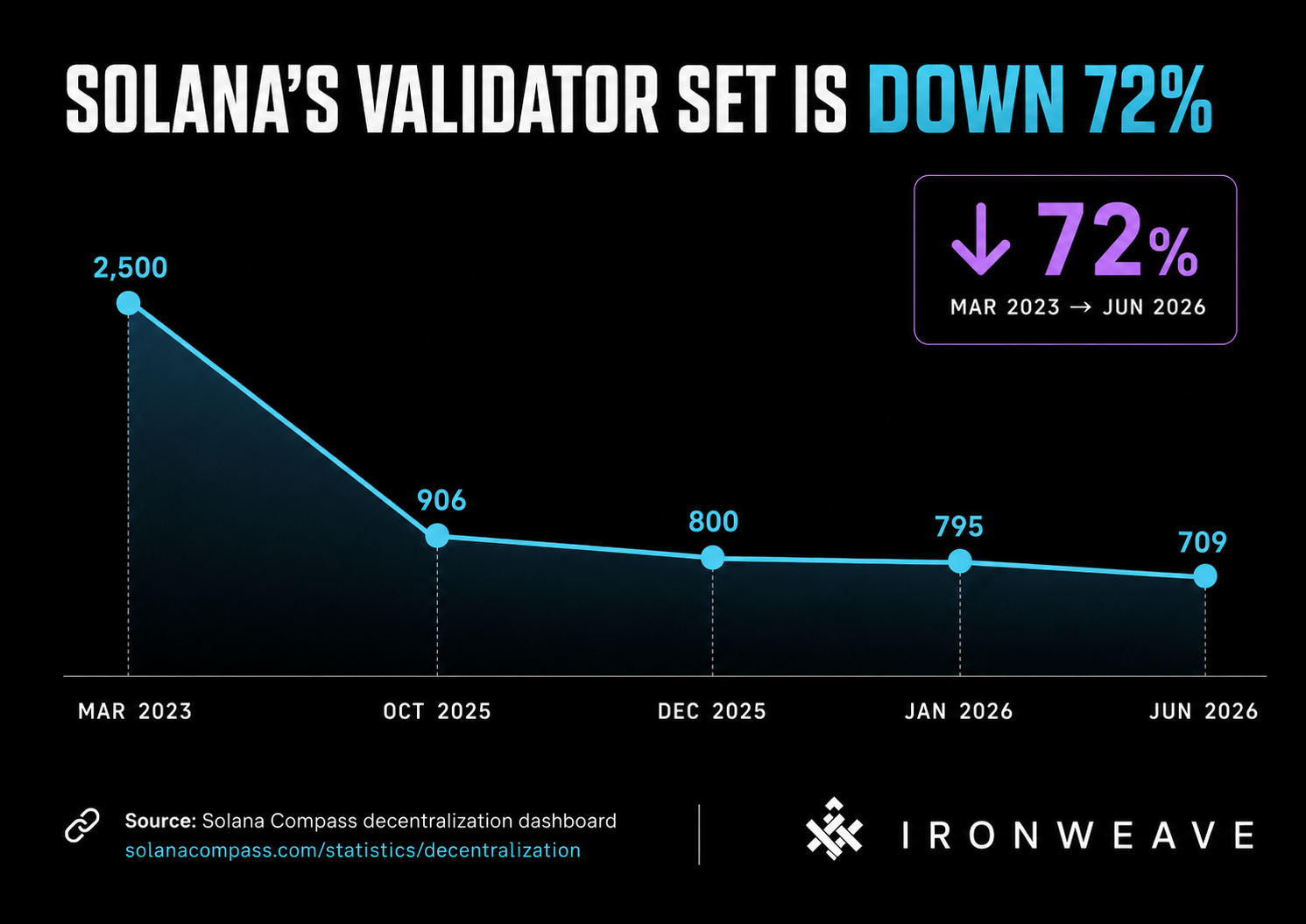
In March 2023, Solana had approximately 2,560 active validators. As of June 2026, that number had fallen to 709. That’s a 72% decrease over that time. (Source: Solanacompass.
I want to be precise about this, because Solana has offered an explanation for some of the decline. Beginning in April 2025, the Solana Foundation began formally pruning validators it deemed underperforming, removing nodes that didn't meet uptime or hardware standards. But pruning doesn't explain the economics that were pushing smaller operators out long before the pruning started. For that, you have to look at what it actually costs to run a Solana validator at all.
The Treadmill That Never Stops
Here's how Solana validator economics work. Every time a validator agrees with the current state of the network, it must submit a vote transaction. That vote transaction costs SOL. It runs continuously, every block, every day, whether your validator's profitable or not.
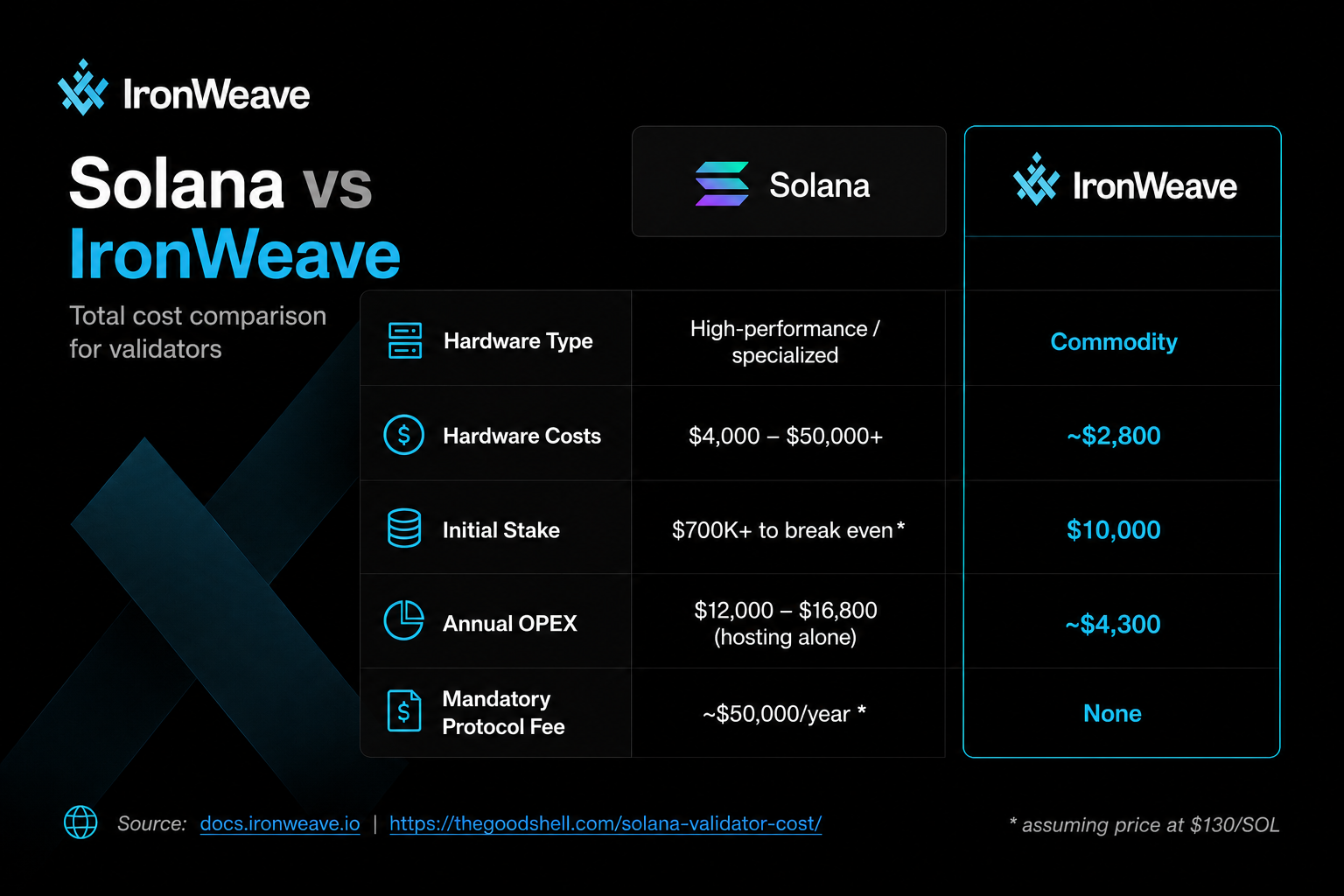
At a SOL price of approximately $130 (which we’ve seen several times, including in Q4 last year) those mandatory vote fees add up to roughly $50,000 per year.
This is a treadmill runs whether you're earning enough to cover it or not.
The network's Nakamoto Coefficient, the minimum number of validators required to compromise or halt the network, has fallen from 31 to 20 over this period. That number's a direct measure of decentralization, and it's moving in one direction.
When cost is the barrier, capital wins. And when capital wins, decentralization loses. Please don’t take this as a criticism of Solana's engineering. Rather, it's a description of what happens when the economics of participation aren't designed from the start to support broad, sustainable participation.
A Different Architectural Bet
IronWeave was designed with this failure mode in mind.
I didn't want to build infrastructure that promised decentralization and then delivered consolidation over time.
An IronWeave validator runs on commodity hardware. No specialized ASICs, no GPU arrays, no enterprise-grade server requirements that only institutional players can afford to rack and maintain. The hardware cost to get started is approximately $2,800, with a one-time setup cost of approximately $1,500 and an initial stake of $10,000.
The annual operating cost, the ongoing, recurring expense a validator carries to stay in the network, is approximately $4,300 per year, or roughly $358 per month.
Validators on IronWeave earn rewards for their participation. The economics are designed so that an individual, a small team, or a developer running a node as a serious side project can participate sustainably.
What a Distributed Network Unlocks
This is where I want to zoom out, because the validator economics are just a preamble to how the future unfolds.
The privacy and sovereignty guarantee of blockchains is only meaningful if the network distributing it can't be captured by a small number of operators. A handful of institutional validators, each running under economics that forced every individual operator out, don't provide the trust guarantee that the architecture promises. The math of consolidation undermines the math of sovereignty.
What a network like this unlocks is something the Internet hasn't had since its earliest days: infrastructure that no single party controls, that scales to meet global demand without compromising the privacy and ownership of the people using it, and that's hardened against the consolidation forces that have bent every previous open network toward centralization over time.
For individuals, it means data that's provably theirs. For enterprises, it means cross-organizational data sharing without trusting an intermediary. For AI systems operating autonomously at scale, it means an operating layer that doesn't require a trusted third party.
For humanity broadly, it means the possibility of digital infrastructure that serves its participants because it's incapable of coercing them.
The validator economics IronWeave was built around are the mechanism that keeps that promise intact over time. Every node that joins and stays is a vote against consolidation and a vote for a better future.
Join the Testnet
IronWeave's testnet is waiting for you. If you've got the technical skills to run a validator and you want to be part of building this from the ground up, we want to hear from you.